
Pro’s and Cons of SEO in 2026: Is It Worth It?
Every business today wants to appear on Google’s first page. But before you invest time and money, you need to understand the full picture. The advantages and disadvantages of Search Engine Optimization (SEO) are both real and significant. On one side, SEO drives organic traffic, builds brand credibility, and delivers one of the highest return on investment (ROI) of any digital marketing channel. According to Bright Edge, SEO generates 1,000% more traffic than organic social media alone.
1. What Is SEO Marketing and How Does It Work?
How does SEO increase organic traffic? SEO marketing is the process of optimizing your website so Google ranks it higher in search engine results pages (SERPs). It covers three core pillars: technical SEO keeping your site fast and crawlable, on page optimization making your content and meta tags relevant, and off page SEO building backlinks and domain authority from other trusted websites. Think of it like setting up the best storefront on the busiest street in your city.
How to start an SEO marketing campaign begins with understanding how Google actually works. Google sends bots to crawl your website, index your pages, and then rank them based on hundreds of signals including relevance, authority, and user experience. Your job through SEO is to make your pages the most useful answer to the searches your targeted audience is already making every single day without any paid advertising required.
2. The Role of SEO in Your Digital Marketing Strategy
SEO does not work in isolation. It feeds every other channel you run. Your keyword research reveals what your audience actually cares about so your email campaigns, social posts, and paid ads become sharper and more relevant. How SEO provides competitive advantage becomes clearest when you realize that organic rankings compound over time while paid traffic stops the moment your budget runs dry completely.
How SEO compares to paid advertising comes down to timing and sustainability. Paid ads deliver instant visibility but cost money every single day. SEO takes longer to build but the traffic it generates costs nothing per click once your pages rank. For USA businesses thinking long term, SEO is the foundation that makes every other marketing channel more efficient and more affordable over time.
SEO vs PPC — Which One Should You Choose?
Choosing between SEO and PPC depends entirely on your timeline and budget. PPC wins when you need traffic this week. SEO wins when you need traffic that keeps growing next year without proportional spending increases. Most competitive USA businesses use both simultaneously to cover every stage of the buying journey effectively without gaps.
Factor | SEO | PPC |
Speed of Results | 6 to 12 months | Immediate |
Cost Per Click | Free after ranking | Paid per click |
Sustainability | Long term compounding | Stops when budget stops |
Trust Level | Higher organic trust | Lower ad trust |
Best For | Long term growth | Immediate revenue needs |
How SEO and Content Marketing Work Together
SEO tells you which topics your audience searches for most. Content marketing creates the articles, videos, and guides that rank for those searches. Neither works at full strength without the other. A blog post targeting a long tail keyword like ‘best CRM software for small business’ can drive 2,000 monthly visitors purely from organic search once it ranks on page one of Google.
- Blog articles targeting informational keywords your audience searches daily
- Product pages optimized for buyer intent keywords ready to convert visitors
- Case studies ranking for comparison and review searches near purchase decision
- FAQ pages capturing featured snippet positions on Google for direct answers
SEO Marketing Approach by Business Type
SEO strategy differs dramatically based on what kind of business you run. A local plumber needs completely different tactics than a national SaaS company. Understanding your business type helps you prioritize the right SEO activities from day one rather than wasting budget on strategies built for a different model entirely.
Business Type | SEO Priority | Key Focus Area |
Local Business | Local SEO | Google Business Profile and local citations |
Ecommerce | Product pages | Technical SEO and product schema markup |
B2B SaaS | Long form content | Thought leadership and domain authority |
Service Business | Service page optimization | Testimonials and local backlinks |
Startup | Long tail keywords | Low competition niche topics first |
3. Top Advantages of SEO Marketing
The advantages and disadvantages of Search Engine Optimization (SEO) start with understanding what SEO genuinely delivers at its absolute best. According to BrightEdge research, organic search drives 53% of all website traffic across industries. No other single channel comes close to that number. Why SEO is a long term marketing strategy becomes obvious when you see how organic traffic compounds month after month without proportional cost increases making it unique among all marketing channels.
SEO pro’s and cons for businesses always begin with the advantages because the upside is genuinely transformational for companies that commit to the process. From website visibility to deep customer behavioral insights, SEO delivers value across your entire business not just your marketing department. Here is every major advantage broken down clearly so you understand exactly what you are investing in before making any commitment.
High ROI Compared to Other Marketing Channels
What is the ROI of SEO marketing? According to Ahrefs, businesses that invest in SEO consistently see average returns of 748% over a three year period. That number dwarfs most paid channels. The reason is simple: once your pages rank, the traffic they generate costs nothing per visitor. Your return on investment (ROI) improves every single month as rankings strengthen and traffic grows without requiring proportional budget increases to sustain that momentum.
- SEO average ROI: 748% over 3 years according to Ahrefs research
- PPC average ROI: 200% but stops immediately when budget is paused
- Social media organic ROI: declining reach and difficult to measure accurately
- Organic traffic from SEO compounds monthly unlike any paid channel available
- Industries with highest SEO ROI: legal, healthcare, financial services, and SaaS
Drives Targeted and Warmer Leads
How to get targeted traffic with SEO starts with keyword intent. Someone searching ‘best CRM software for small business’ is already deep in the buying journey. They know what they want and they are actively comparing options. That person is infinitely warmer than someone who sees a random Facebook ad while scrolling vacation photos on a Saturday afternoon with no buying intention whatsoever.
- Informational keywords attract readers in active research mode
- Commercial keywords attract buyers comparing competing solutions
- Transactional keywords attract people ready to purchase immediately today
- Local keywords attract customers near your physical business location
- Targeted audience reached through SEO converts at 14.6% versus 1.7% for outbound methods
Builds Long Term Brand Authority and Credibility
Does SEO build brand authority? Absolutely. When your website appears on the first page of Google for five different searches your potential customer makes in one week, they begin to see you as the go to expert in your space. That trust accumulates silently and powerfully. Brand credibility built through consistent website ranking translates directly into higher conversion rate even when visitors do not click from Google directly.
- Consistent first page rankings signal expertise to potential customers automatically
- Users trust organic results more than paid advertisements by a significant margin
- Domain authority growth reinforces credibility with both users and search engines
- Repeated brand exposure through multiple organic rankings builds recognition over time
Cost Effective and Emphasizes Skill Over Spend
Why is SEO a cost effective marketing strategy? Because a solo blogger with excellent content strategy can outrank a Fortune 500 company with a mediocre website. SEO rewards relevance and expertise over raw budget. A $500 investment in a well researched article can deliver years of organic traffic while a $500 Facebook ad campaign disappears the moment the budget runs out with nothing permanent left behind for your business.
- Free SEO tools: Google Search Console, Google Analytics, Google Keyword Planner
- Low cost tools: Ubersuggest at $29 per month, Ahrefs Webmaster Tools free tier
- Content optimization skill matters more than advertising budget in SEO
- Once rankings are established, maintenance costs far less than initial investment
Improves Website Usability and User Experience
How SEO improves user experience is one of its most underappreciated advantages. Google’s Core Web Vitals require your site to load fast, respond quickly on mobile, and maintain visual stability as pages load. Meeting these standards improves user experience for every visitor regardless of how they find your site. Improving page load speed from 4 seconds to 1.5 seconds increases conversions by up to 27% in real world case studies published by Google.
- Mobile responsiveness improvements benefit both rankings and visitor satisfaction
- Faster load times reduce bounce rates and increase pages per session significantly
- Clear site structure helps both Google crawlers and human visitors navigate easily
- On page optimization forces you to improve content quality for readers not just search engines
Provides Deep Insight Into Customer Behaviour
How SEO helps customer behaviour analysis gives you a permanent competitive advantage. Google Search Console shows you exactly which queries bring people to your site. Google Analytics shows what they do after arriving. Together these tools reveal what your audience actually wants versus what you assume they want. That gap between assumption and reality is where most marketing budgets get wasted year after year without anyone noticing.
- Keyword research uncovers questions your audience asks that your competitors have not answered
- Click through rate data shows which titles and descriptions resonate with real searchers
- Behavioral flow data shows where visitors drop off and where they convert on your site
- SEO tools reveal seasonal demand patterns that inform your content calendar planning
4. Disadvantages of SEO Marketing You Must Know
What are the disadvantages of SEO? The honest answer is that SEO is demanding, slow, and unpredictable in ways that genuinely surprise businesses who approach it with unrealistic expectations. The advantages and disadvantages of Search Engine Optimization (SEO) demand equal honesty about the real challenges. Ignoring these disadvantages leads to wasted budgets, broken expectations, and abandoned strategies that were actually starting to work just before the team gave up entirely.
What are the risks of SEO marketing? They range from slow returns in the early months to sudden ranking drops caused by algorithm updates you had no warning about. Understanding these risks before you start protects your budget and helps you set realistic expectations with every stakeholder in your business who is watching the results and waiting for the strategy to deliver.
Slow to Show Results — Patience Required
How long does SEO take to show results? For most new websites, meaningful organic traffic takes 6 to 12 months of consistent effort before appearing in analytics. Established sites in competitive niches often wait 18 months before breaking onto the first page for their target keywords. This slow startup timeline makes SEO a poor fit for businesses that need revenue within 60 to 90 days without any alternative traffic source bridging the gap in the meantime.
- Months 1 to 3: technical fixes and content foundation with minimal traffic impact
- Months 4 to 6: early keyword rankings appearing for long tail searches
- Months 7 to 12: meaningful traffic growth beginning for target keywords
- Months 12 plus: compounding returns and competitive keyword rankings emerging
Constant Algorithm Changes Create Uncertainty
How Google algorithm changes affect SEO is one of the most frustrating realities of this channel. Google makes between 500 and 600 algorithm updates per year. Major updates like Helpful Content and Core Updates have wiped out the rankings of previously successful sites overnight. Why SEO results are uncertain comes directly from this lack of control over the platform your rankings depend on completely and permanently.
- Build content around genuine user value rather than algorithm manipulation tactics
- Diversify traffic sources so no single channel represents more than 50% of your visits
- Monitor Google Search Console weekly for any manual actions or traffic drops
- Follow reliable SEO news sources like Search Engine Journal and Search Engine Land
Requires Specialist Skills and Consistent Effort
Why SEO requires specialist skills becomes obvious the moment you look at how many distinct disciplines modern SEO covers. Technical SEO alone requires understanding of crawl budgets, schema markup, Core Web Vitals, and site architecture. Add content optimization, link building, analytics interpretation, and competitive research and you have a full time job that demands genuine expertise across multiple overlapping fields simultaneously.
SEO Specialist Type | Average USA Salary 2026 | Key Skills |
Technical SEO Specialist | $75,000 to $95,000 | Site speed, crawlability, schema |
Content SEO Strategist | $65,000 to $85,000 | Keyword research, content planning |
Link Building Specialist | $55,000 to $75,000 | Outreach, backlink analysis |
SEO Manager | $85,000 to $120,000 | Strategy, team management, reporting |
Highly Competitive in Most Niches
Trying to rank for ‘best running shoes’ means competing against Nike, Adidas, REI, and Runner’s World simultaneously. Every one of those sites has decades of domain authority, thousands of backlinks, and entire teams dedicated to SEO. Breaking into competitive niches without a multi year strategy and serious budget is genuinely difficult for most small businesses in the USA market today regardless of content quality.
- Target long tail keywords with lower competition and higher purchase intent first
- Build topical authority in a narrow niche before expanding to broader competitive terms
- Use SEO tools like Ahrefs and Semrush to identify keyword difficulty before targeting
- Focus on geographic modifiers to reduce competition for local service businesses
Limited Control Over Search Engine Decisions
You optimize your site perfectly and then Google releases an update that drops your rankings by 40% overnight. It happens regularly and there is nothing you can do about it after the fact. Domain authority you spent years building can evaporate if Google decides your content no longer meets their evolving quality standards. This lack of control is the most psychologically challenging aspect of SEO for business owners who prefer predictable marketing returns above all else.
- A manual action penalty can remove your site from search results entirely with no warning
- Backlinks from sites that later get penalized can drag your rankings down with them
- Google’s interpretation of user experience signals changes without public announcement
- Dependence on external factors like other sites linking to you adds permanent unpredictability
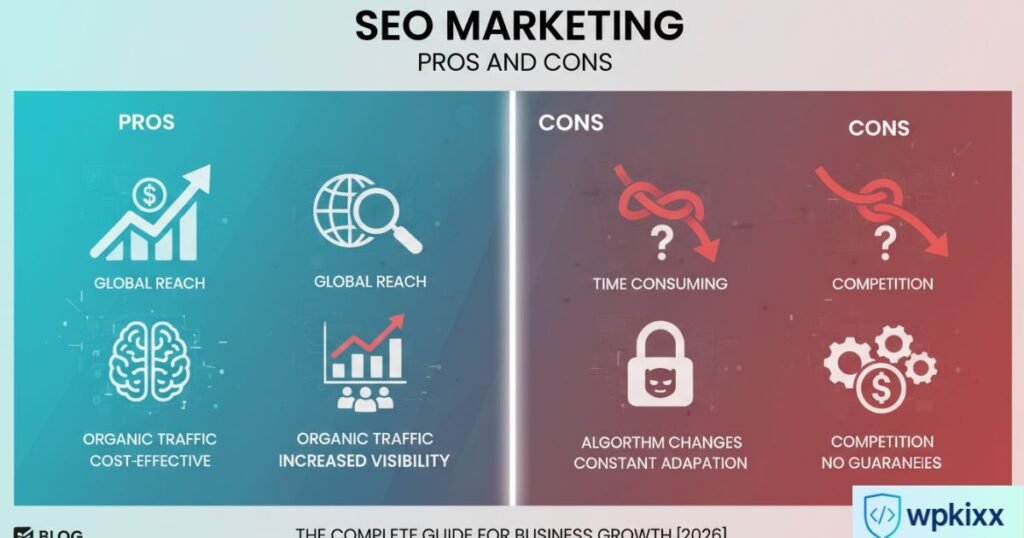
5. SEO Pro’s and Cons: Side by Side Comparison
If you want the clearest single view of the advantages and disadvantages of Search Engine Optimization (SEO) in one place, this comparison table delivers it without fluff or unnecessary complexity. Use this as your quick reference when presenting the SEO case to your team, your boss, or your clients. Every factor that matters to a USA business decision maker is covered directly and honestly.
SEO pro’s and cons for businesses ultimately come down to your timeline, your budget, your competition level, and your tolerance for slow building strategies that eventually outperform every alternative channel available. No other marketing channel rewards patience as generously as SEO does over a multi year time horizon.
Factor | Advantage | Disadvantage |
Cost | Low long term cost per visitor | High initial investment in time and expertise |
Speed | Sustainable compounding growth | 6 to 12 months before meaningful results |
Traffic Quality | Highly targeted warm leads | No guaranteed volume or consistency |
Brand Impact | Builds credibility and authority | Takes months before users notice the brand |
Control | Data rich and fully measurable | Algorithm changes create unpredictability |
Skill Required | Levels playing field against bigger budgets | Needs specialist expertise to execute well |
Competition | Better content can beat larger competitors | Established sites hold massive head starts |
Longevity | Results compound over years automatically | Requires ongoing maintenance and investment |
ROI | 748% average over 3 years | ROI invisible for first 6 to 12 months |
Risk | Low risk when done ethically | High risk if black hat tactics are used |
6. Is SEO Worth It? How to Know If It Fits Your Business
Is SEO worth it for small businesses? The honest answer is: it depends entirely on your situation. The advantages and disadvantages of Search Engine Optimization (SEO) ultimately come down to one practical question: does your target customer search for your product or service online before buying? If yes, SEO is probably worth serious investment. If your customers discover you purely through referrals, SEO may not be your highest priority channel right now.
How SEO compares to paid advertising for small businesses comes down to compounding versus renting. PPC rents you an audience as long as you keep paying. SEO builds an audience you eventually own completely. For businesses with 12 plus months of runway and a content friendly industry, SEO consistently delivers the strongest long term return of any digital channel available in 2026 for USA businesses.
When SEO Is the Right Choice for Your Business
SEO fits your business when you have time, consistent content capacity, and customers who actively search for what you sell. These are the strongest indicators that SEO will deliver meaningful returns for your specific situation in the competitive USA market where organic search dominates discovery across nearly every industry vertical currently.
- Your customers search for your product or service category on Google regularly
- You can produce or commission consistent high quality content every month
- Your competitors rank well organically meaning SEO clearly works in your niche
- You have a 12 plus month timeline before needing organic traffic to drive revenue
- Your business model benefits from targeted audience traffic rather than mass exposure
When SEO Might Not Be Your Best Option Right Now
What are the risks of SEO marketing for businesses in the wrong situation? Primarily wasted budget and broken morale when results take longer than expected. These specific signals indicate SEO should wait or be deprioritized in favor of faster return channels that match your current business stage and timeline requirements more accurately.
- You need revenue within 60 to 90 days with no alternative traffic source available
- Your product or service has zero search demand and customers do not look online
- Your budget is under $500 per month making meaningful SEO practically impossible
- Your industry is so competitive that first page rankings require years of sustained effort
- You lack the internal capacity to produce quality content consistently every single month
How to Combine SEO With Other Marketing Channels
The smartest USA marketing strategies in 2026 combine SEO with complementary channels that cover its weaknesses. PPC bridges the gap while SEO builds momentum. Social media amplifies SEO content and generates natural backlinks. Email converts the organic traffic SEO delivers into actual paying customers who return repeatedly without any additional acquisition cost required from your budget.
- Allocate 40% of budget to PPC for immediate traffic while SEO builds organically
- Use social media to distribute SEO content and generate natural social signals
- Build an email list from organic visitors to create a traffic source independent of Google
- Use SEO tools data to inform your PPC keyword targeting for immediate efficiency gains
7. How to Get Started With an SEO Marketing Campaign
Understanding the advantages and disadvantages of Search Engine Optimization (SEO) is step one but taking action is where growth actually begins. How to start an SEO marketing campaign does not require a massive budget or a large technical team. It requires a clear four step process executed consistently over time. Every successful SEO campaign in the USA market follows the same foundational framework regardless of industry or company size.
Most businesses overcomplicate their SEO starting point. You do not need 50 tools or a 200 page strategy document. You need four clear steps executed with discipline every single month until the results start compounding on their own momentum and the organic traffic begins to flow consistently into your business pipeline.
Step 1 — Keyword Research and Topic Planning
Keyword research is the foundation of every successful SEO campaign. Start by understanding what your targeted audience actually searches for rather than what you assume they search for. Use Google Search Console for free data on your existing rankings and Google Keyword Planner for volume estimates on new target keywords before committing to any content creation investment.
- Target long tail keywords with 100 to 1,000 monthly searches and low competition scores
- Group related keywords into topic clusters rather than targeting single isolated terms
- Prioritize keywords with clear buyer intent over purely informational searches
- Build a 90 day content calendar mapping one keyword per article published each week
Step 2 — On Page SEO Optimization Basics
On page optimization covers every element on your page that signals relevance to Google. Your title tag, meta tags, H1 heading, and first paragraph should all contain your primary keyword naturally. Internal linking between related pages helps Google understand your site structure and distributes domain authority across your most important pages efficiently without any additional cost to your budget.
- Title tags: keep under 60 characters and include your primary keyword near the front
- Meta tags: write compelling descriptions under 155 characters that improve click through rate
- Content optimization: aim for comprehensive topic coverage not just keyword density targets
- Mobile responsiveness: over 60% of USA searches happen on mobile devices in 2026
Step 3 — Building Authority Through Link Building
Link building remains one of the strongest ranking signals Google uses in 2026. One backlink from a domain authority 70 website delivers more ranking power than fifty links from domain authority 20 sites combined. Quality dramatically outweighs quantity in modern link building strategy for USA businesses trying to compete effectively against established market leaders.
- Guest posting: write valuable articles for industry websites in exchange for a backlink
- Digital PR: create data driven studies or original research that journalists want to cite
- Resource page outreach: find curated resource lists in your niche and pitch your best content
- Never purchase cheap backlinks from link farms as Google penalizes these aggressively
Step 4 — Tracking and Measuring SEO Results
How SEO helps customer behaviour analysis only works if you set up proper tracking before your campaign begins. Google Search Console and Google Analytics 4 are both free and together they give you everything you need to measure organic traffic, keyword performance, conversion rate, and user experience signals that inform your next optimization decisions and keep your strategy improving month after month.
- Track organic sessions monthly and compare to the previous period for growth trends
- Monitor keyword rankings weekly using Google Search Console position data for free
- Measure conversion rate from organic traffic separately from paid and direct sources
- Set up goal tracking in Google Analytics 4 to connect SEO traffic to actual business outcomes
8. Common SEO Marketing Mistakes to Avoid
Knowing the advantages and disadvantages of Search Engine Optimization (SEO) means nothing if these common mistakes quietly destroy your progress from the inside. Most SEO failures in the USA market come from avoidable errors rather than SEO being fundamentally ineffective as a channel. The businesses that fail at SEO almost always commit several of these mistakes simultaneously and then blame the strategy rather than their own execution approach.
Why SEO requires specialist skills becomes painfully obvious when you see how many ways an untrained approach can actively hurt your website ranking rather than improving it. Avoid every item on this list before spending a single dollar on SEO services or SEO tools to ensure your foundation is solid from the very beginning of your campaign.
- Targeting keywords that are too competitive for your current domain authority level
- Publishing thin content under 800 words that provides no genuine value to readers
- Ignoring technical SEO issues like broken links, slow page speed, and crawl errors
- Over optimizing meta tags with exact match keywords in an unnatural and spammy way
- Expecting results within 30 to 60 days and abandoning the strategy prematurely
- Buying cheap backlinks from link farms that damage your site’s reputation with Google
- Creating content without keyword research and hoping it accidentally ranks on its own
- Failing to update and refresh old content that is losing rankings to fresher competitor pages
- Mobile responsiveness ignored when over 60% of USA searches happen on mobile devices
- Never tracking results meaning you cannot identify what is working or what needs improvement
9. The Future of SEO Marketing in 2026 and Beyond
The advantages and disadvantages of Search Engine Optimization (SEO) are evolving faster in 2026 than at any point in the past decade. AI powered search features like Google’s AI Overviews are reshaping how organic results appear and which content earns the most visibility. How Google algorithm changes affect SEO in 2026 is increasingly about satisfying the intent behind a search rather than matching the exact keywords in the query itself.
Why SEO is a long term marketing strategy becomes even more true as AI search evolves. Brands that build genuine expertise, consistent publishing schedules, and strong domain authority will benefit most from every algorithm evolution ahead. The businesses that chase shortcuts will find their rankings disappearing faster than ever before in the coming years as Google’s quality filters become more sophisticated and harder to manipulate artificially.
Key trends reshaping SEO in 2026 and beyond:
- AI Overviews are changing which pages receive clicks from informational searches
- E E A T requirements (Experience, Expertise, Authoritativeness, Trustworthiness) are strengthening
- Voice search optimization is growing as smart speaker usage increases across USA households
- Zero click searches are increasing meaning featured snippets deliver brand exposure without clicks
- Video SEO is growing as YouTube becomes the second largest search engine globally
- Generative Engine Optimization (GEO) is emerging as AI chatbots become discovery channels
- User experience signals are becoming more important than keyword optimization alone
Top Seo Tools
Ahref site audit or keyword research
Semrush site audit or keyword research
Ubbersuggest site audit or keyword research
10. FAQs About SEO Marketing Pro’s and Cons
Why is SEO so difficult for new websites to crack?
New websites start with zero domain authority, no backlinks, and no established trust signals with Google. Search engines favor websites with proven track records of quality content and reliable user satisfaction over time. How long does SEO take to show results for new sites is typically 6 to 12 months before meaningful organic traffic begins appearing consistently in analytics reports for most industries.
What are the biggest risks of relying solely on SEO for website traffic?
What are the risks of SEO marketing when used as your only traffic source? A single algorithm updates event can cut your traffic by 40% to 80% overnight with no warning. Diversifying across paid, social, email, and organic channels protects your business from catastrophic single channel dependence that has destroyed otherwise healthy businesses in the past without warning.
How long does SEO realistically take to show meaningful results?
How long does SEO take to show results realistically depends on your domain’s history, competition level, and content quality. New websites typically see initial rankings in months 3 to 6 and meaningful organic traffic growth in months 9 to 12. Established sites in competitive niches may need 18 to 24 months of consistent effort to break through to page one rankings for their most valuable target keywords.
Is SEO worth the investment for small businesses in the USA?
Is SEO worth it for small businesses? Yes if your customers search for your product or service category online and you have at least 12 months of patience for results to develop. Small businesses using local SEO particularly benefit from the competitive advantage that first page Google rankings provide against larger competitors with bigger advertising budgets in their local markets.
What is the difference between SEO and SEM?
SEO focuses on earning organic traffic through unpaid website ranking improvements. SEM encompasses both SEO and paid advertising like Google Ads. How SEO compares to paid advertising shows that SEO delivers sustainable long term returns while SEM’s paid component delivers immediate but temporary visibility that stops the moment your budget is exhausted completely.
Can SEO work without content marketing?
Why SEO is a long term marketing strategy is partly because content is its fuel. Without consistent content optimization and new page creation targeting fresh keywords, SEO eventually stagnates completely. Google rewards websites that regularly publish helpful, original, expert level content. SEO without content marketing is like a car without fuel: the engine exists but it goes nowhere meaningful for your business.
How much does professional SEO cost for a USA small business in 2026?
Professional SEO services in the USA range from $500 to $2,000 per month for small business packages from freelancers and boutique agencies. Mid size agency retainers typically run $2,000 to $8,000 per month. What is the ROI of SEO marketing at these price points depends heavily on your industry, competition level, and how consistently the strategy is executed over 12 plus months of sustained effort.
What happens to my rankings if I stop doing SEO completely?
Why SEO requires specialist skills includes understanding what happens when you stop entirely. Rankings decline gradually as competitors continue publishing new content and earning fresh backlinks while your site sits static. Most sites lose 20% to 40% of their organic traffic within 6 to 12 months of stopping SEO activity depending on how competitive their target keywords are in their specific industry.
Conclusion
The advantages and disadvantages of Search Engine Optimization (SEO) paint a clear picture for any USA business owner willing to look honestly at both sides. SEO delivers extraordinary long term value through compounding organic traffic, unmatched return on investment (ROI), and brand credibility that no paid channel can replicate at scale. However it demands patience, specialist expertise, and consistent effort before those returns materialize in any meaningful and measurable way.
Why SEO is a long term marketing strategy is not a warning. It is actually its greatest strength. The businesses that start today and commit for 12 months will own a traffic asset that keeps delivering value for years ahead. Start with one keyword. Write one great article.