

How to Find Competitors in 2026 Ultimate Guide for US Businesses
Understanding how to find competitors is one of the most valuable skills any US business owner or marketer can develop. Without a clear picture of your competitive landscape), you are making product, pricing, and marketing decisions without the intelligence needed to position your business effectively. A thorough competitor analysis reveals who is targeting your same customers, what market advantages they hold, where their weaknesses create openings for you, and which keyword research opportunities they have already validated through their own content investment. This guide walks you through every proven method to identify both direct and indirect competitors so you build strategies grounded in real market research rather than assumptions.
1. What Does It Mean to Find Your Competitors?
Finding your competitors means identifying every business that competes for the same customers, budget, or attention that your business targets. When US marketers ask how to find competitors, they are really asking two questions simultaneously: who is targeting the same customers right now, and who could realistically take those customers away in the future. The first question identifies your current competition — businesses already selling similar products or services to your target audience. The second identifies emerging threats — new entrants, substitute solutions, and adjacent businesses that could expand into your space. Both categories require monitoring for a complete competitive intelligence picture that actually protects your market position.
Competitor research matters because every strategic decision you make — pricing, positioning, product development, marketing channels — becomes more effective when informed by real market data rather than guesswork. According to SBA.gov, US small businesses that conduct regular competitive analysis are significantly more likely to achieve sustained growth than those operating without structured market intelligence. Understanding your competitive landscape helps you identify pricing gaps, underserved customer segments, content opportunities your competitors miss, and positioning angles that differentiate your brand meaningfully in crowded markets where customers have many alternatives to choose from.
Direct vs Indirect vs Substitute Competitors
Before learning how to find competitors, understand the three categories you are looking for. Direct competitors sell the same product or service to the same target customer — a competing coffee shop two blocks away is your direct competitor. Indirect competitors solve the same customer problem through a different solution — a meal kit delivery service is an indirect competitor to your grocery store because both solve the dinner preparation problem through different means. Substitute competitors offer completely different products that compete for the same customer budget — streaming services compete with movie theaters even though they offer different experiences. Identifying all three competitor types gives US businesses a complete view of their market competition rather than just the most obvious head-to-head rivals.
New Entrants: The Competitors You Have Not Met Yet
New entrant competitors are businesses entering your market space that do not yet have an established presence — startups, expanding companies from adjacent markets, and international businesses entering the US market. These competitors are harder to identify through standard competitor research methods because they lack the search rankings, social media presence, and customer reviews that make established competitors easy to find. Monitor new entrant activity through Google Alerts for your industry keywords, startup databases like Crunchbase, industry trade publications, and social media monitoring for new brand mentions in your market space. Catching new entrants early — before they gain market traction — gives you time to respond strategically rather than reactively after they have already taken market share.
2. How to Find Competitors Using Google Search and SERP Analysis
Google search is the fastest free method to find competitors for any US business in 2026. Search for the keywords your customers use to find your product or service — the businesses appearing on page one of Google for those terms are your primary search competitors regardless of whether you knew they existed before. For a local US service business, search your service plus your city — plumber Chicago or wedding photographer Austin — and document every business appearing in both the organic results and the Google Maps local pack. These businesses are actively competing for the same local customer searches that drive your inquiries and bookings.
The Google Search Engine Results Page (SERP) reveals competitor intelligence beyond just business names. Study the page titles and meta descriptions of top-ranking competitor pages — they reveal how competitors position themselves and what customer benefits they lead with. Note which competitors appear in multiple result types simultaneously — organic listings, Google Maps, featured snippets, and paid ads — as omnipresent competitors invest heavily in digital marketing and represent your most serious online competition. Use Google’s related searches at the bottom of results pages to discover additional keyword angles that reveal competitors you might miss by searching only your primary service terms.
Using Google Ads to Identify Paid Search Competitors
Google Ads results reveal a specific subset of competitors — businesses investing real money to capture your target customers through paid search. Run searches for your most valuable keywords and document every business appearing in the paid results above organic listings. These paid competitors have validated that your target keywords drive commercial value — they would not pay per click unless those keywords deliver customers. Tools like SpyFu and Semrush reveal which keywords any competitor bids on, what their ad copy says, and how long they have been running specific campaigns — historical paid data that reveals their most profitable customer acquisition channels and the keywords they consider most commercially valuable for their business.
Analyzing Google Maps for Local Competitors
For US local businesses, Google Maps competitor analysis is as important as organic search competitor research. Search your service category in Google Maps and document every business appearing in the local pack and map results — these are your direct geographic competitors competing for the same local customer searches. Study their Google Business Profile listings carefully — their service descriptions reveal how they position themselves, their photo galleries show their brand presentation, and their review counts and ratings indicate their market reputation strength. Competitors with hundreds of five-star reviews hold a significant trust advantage that requires a deliberate reputation management strategy to overcome in local market competition.
3. How to Find Competitors Using Keyword Research Tools
Keyword research tools are the most systematic method to find competitors for US businesses with an online presence. Enter your primary keywords into Ahrefs, Semrush, or SE Ranking and look at the organic search results data — every domain consistently ranking for your target keywords is a search competitor worth analyzing. These tools reveal competitor data that Google search alone cannot show: estimated monthly traffic each competitor receives from your target keywords, their full organic keyword portfolio showing every term they rank for, their domain authority indicating overall SEO strength, and their top-performing pages driving the most traffic for your shared keyword space.
Semrush’s Market Explorer tool takes competitor discovery further by mapping the competitive landscape for any industry or keyword cluster — showing market share distribution, traffic trends, and audience overlap between competing domains. This market-level view reveals competitors you might never discover through individual keyword searches because they target different keywords but serve the same customer audience through different content angles. Ahrefs’ Competing Domains report automatically identifies which websites most frequently appear alongside your domain in Google search results — surfacing your true search competitors based on actual SERP co-occurrence data rather than manually guessing which businesses compete with you for specific terms.
Using Keyword Gap Analysis to Find Content Competitors
Keyword gap analysis identifies competitors who rank for valuable keywords your site does not — revealing both competitors and content opportunities simultaneously. In Semrush or Ahrefs, enter your domain alongside three to five competitor domains to generate a gap report showing every keyword your competitors rank for that you currently miss. Sort these gap keywords by search volume and keyword difficulty to prioritize the highest-traffic, most winnable opportunities. Domains appearing repeatedly in your gap analysis across multiple keyword clusters are your most significant content competitors — businesses that have built comprehensive topical authority in your space that your content strategy needs to systematically address to compete effectively for organic traffic.
Free Keyword Tools for Finding Competitors on a Budget
US small businesses on tight budgets can identify search competitors using free tools before investing in paid platforms. Google Keyword Planner shows which businesses run ads for your target keywords — type your keywords and review the auction insights for advertiser presence. Google Search Console reveals which queries your site already ranks for — helping you identify your current search position and which competitors rank ahead of you for your existing terms. Ubersuggest’s free tier provides basic competitor domain analysis showing top pages and keyword rankings for any domain. These free tools provide sufficient competitor intelligence for initial market research — upgrade to paid platforms as your competitive strategy matures and the stakes of keyword selection decisions increase with your organic traffic growth.
4. Types of Competitors and How to Identify Each One
Different competitor types require different identification methods. A systematic approach to how to find competitors addresses all four competitor categories rather than focusing exclusively on the most obvious direct competition that every US business owner already knows about.
| Competitor Type | Definition | How to Find Them | Example |
|---|---|---|---|
| Direct competitors | Same product, same customer | Google search, keyword tools, industry directories | Two coffee shops on the same street |
| Indirect competitors | Different product, same customer problem | Customer surveys, SERP analysis, social listening | Coffee shop vs energy drink brand |
| Substitute competitors | Different product, same budget | Customer interviews, market research reports | Cinema vs streaming service |
| New entrants | Emerging businesses entering your space | Crunchbase, Google Alerts, trade publications | Funded startup targeting your niche |
| Online-only competitors | Digital businesses targeting your keywords | SEO tools, SERP analysis, PPC research | E-commerce competitor vs local store |
How to Find Direct Competitors
Direct competitors are the easiest category to identify when learning how to find competitors for your US business. Search Google for your exact product or service name plus your target market — the businesses appearing consistently in results are your direct competitors. Check industry association directories — most US trade associations publish member directories that list all businesses operating in your specific market segment. Search Amazon, Yelp, or industry-specific directories for your product category — businesses listed alongside yours in these directories are direct competitors bidding for the same customer attention. Ask your sales team which competitor names prospects mention most frequently during purchase discussions — direct competitor knowledge often lives in your own sales conversations before any formal research begins.
How to Find Indirect Competitors
Indirect competitors require more creative research because they do not appear in the same search results or directories as your business. Customer interviews are the most reliable method — ask your best customers what other solutions they considered before choosing you and what they would use if your product disappeared tomorrow. Their answers reveal the indirect competitors actually competing for your customer’s problem-solving budget. Social media listening using tools like Brandwatch or Mention surfaces conversations where your target customers discuss alternative solutions to the problem your product solves — revealing indirect competitors through authentic customer language rather than your own assumptions about which alternatives customers consider viable substitutes.
5. How to Find Competitors Using Social Media Research
Social media platforms are powerful free tools for finding competitors that your target US customers already follow and engage with. Search your primary product or service keywords on Instagram, TikTok, LinkedIn, and Facebook — businesses appearing consistently in these results are investing in social content to reach your target audience. On LinkedIn, search your industry and location to find companies competing for the same professional audience. On Instagram and TikTok, search relevant hashtags in your product category to discover which brands produce content your potential customers consume — these content competitors may not rank highly on Google but win significant customer attention through social channels that traditional SEO competitor analysis completely misses.
Facebook Groups and Reddit communities in your industry niche are particularly valuable for discovering indirect competitors and understanding how customers perceive different solutions. Search for Facebook Groups related to your product category and observe which brands members recommend, mention, or complain about. Reddit’s industry subreddits contain authentic conversations where US customers discuss their purchasing decisions, the products they use, and the businesses they trust — revealing competitor brands that your target customers actually choose rather than just the ones that appear prominently in search results. These community conversations provide competitive intelligence that formal market research tools rarely capture because they reflect genuine unsolicited customer opinions rather than survey responses shaped by how questions are framed.
Using LinkedIn for B2B Competitor Research
LinkedIn is the most powerful social platform for finding competitors in US B2B markets. Search your industry, job function, and service category to identify companies actively targeting the same business customers you serve. LinkedIn’s Company Pages reveal competitor team sizes, recent hires indicating growth areas, content strategy through their posted articles and updates, and employee skill profiles suggesting their technical capabilities. Monitor competitors’ LinkedIn activity for product announcements, partnership news, and hiring patterns — a competitor suddenly hiring multiple enterprise sales representatives signals an upmarket expansion move worth noting in your competitive strategy. LinkedIn Sales Navigator provides the most comprehensive B2B competitor intelligence on the platform for US businesses that invest in systematic competitive monitoring.
Social Listening Tools for Ongoing Competitor Discovery
Social listening tools automate ongoing competitor monitoring beyond the initial discovery phase. Google Alerts — the free option — sends email notifications whenever your competitor names or industry keywords appear in new web content. Set up alerts for each identified competitor’s brand name, their key products, and your primary industry keywords to receive automatic competitor intelligence daily without manual searching. Paid tools like Mention, Brandwatch, and Sprout Social monitor competitor social media activity, brand mentions, and sentiment trends across all major platforms simultaneously — providing comprehensive competitive intelligence for US businesses that make ongoing competitor monitoring a core part of their marketing strategy rather than a periodic manual exercise.
6. How to Find Competitors Using Market Research and Customer Feedback
Market research provides the most authoritative foundation for finding competitors because it grounds competitor identification in actual customer behavior rather than search engine data or social media observation. US businesses conducting structured market research — through customer surveys, focus groups, or customer interviews — consistently discover competitors that digital research methods miss because customers reveal the full consideration set of alternatives they evaluate during purchasing decisions, including word-of-mouth recommendations, locally known brands, and niche specialists that lack significant online visibility but win significant business through relationship and reputation channels.
Customer feedback is the single most valuable source of competitor intelligence available to established US businesses. Your existing customers chose you over alternatives — asking them directly what other options they considered before purchasing reveals your true competitive landscape as customers actually experience it. Structure customer interviews around three questions: what other solutions did you consider before choosing us, what would you use if we were not available, and what do you wish we offered that you currently get elsewhere. These three questions consistently surface both known competitors and surprising alternatives that no keyword research or SERP analysis would have identified, because they reflect the actual mental models customers use during their purchasing journey rather than their search behavior afterward.
Using Industry Reports and Trade Publications
Industry reports from research firms like Gartner, IBISWorld, and Forrester provide comprehensive competitor lists for established US market categories — these reports map the competitive landscape professionally and include market share data, growth trends, and competitive positioning analysis that would take months to compile independently. Many US public libraries including the Brooklyn Public Library provide free business database access to IBISWorld, Mergent, and other competitor intelligence databases that cost thousands of dollars for direct subscriptions. Trade association publications in your specific industry publish annual competitive landscape reviews — SHRM for HR technology, ABA for banking, NAR for real estate — that identify the major and emerging competitors your industry association tracks as significant market participants.
Competitive Benchmarking Through Customer Surveys
Customer surveys specifically designed for competitive benchmarking reveal how your US customers perceive your positioning relative to competitors across specific attributes — price, quality, service, brand reputation, and product features. Include a question asking respondents to name other brands they considered or currently use for your product category — this unaided recall data reveals your true consideration set competitors based on what customers actually think of, not what appears in search results. Track these survey results quarterly to detect shifts in your competitive landscape — new competitor names appearing in customer surveys signal emerging threats worth monitoring more closely through your ongoing competitive intelligence program before they accumulate enough market traction to seriously threaten your customer retention rates.
7. Best Tools to Find and Monitor Competitors in 2026
The right tools transform finding competitors from a manual research exercise into a systematic intelligence operation. US businesses in 2026 have access to a powerful ecosystem of competitor research tools ranging from free Google-native options to enterprise competitive intelligence platforms. The best tool combination depends on your budget, your primary competitive focus — search, social, or overall market — and whether you need one-time competitor discovery or ongoing competitive monitoring that alerts you to market changes as they happen rather than weeks after the fact when your customers have already noticed them.
| Tool | Best For | Price | Key Competitor Feature |
|---|---|---|---|
| Semrush | Full search competitor analysis | $139.95/mo | Market Explorer + Competitor research |
| Ahrefs | Organic keyword competitor research | $129/mo | Competing Domains report |
| SpyFu | PPC + SEO competitor keywords | $33/mo | Every competitor keyword ever bid on |
| SE Ranking | Budget all-in-one competitor research | $65/mo | Competitor analysis module |
| SimilarWeb | Traffic and audience competitor data | Free/Paid | Traffic sources and audience overlap |
| Brandwatch | Social media competitor monitoring | Custom | Social listening and sentiment |
| Google Alerts | Free ongoing competitor monitoring | Free | Brand and keyword mention alerts |
| Crunchbase | Startup and new entrant discovery | Free/Paid | Funded company tracking by category |
How to Use Semrush to Find Competitors
Semrush is the most comprehensive tool for US businesses learning how to find competitors across both organic and paid search channels. Enter your domain into Semrush’s Domain Overview to see your automatically identified competitors in the Organic Competitors widget — Semrush calculates these based on keyword overlap between your domain and others in its database. Click through to the Competitors report for a full ranked list of domains sharing the most organic keyword positions with you. Use the Market Explorer tool by entering your industry category to see the full competitive landscape map — plotting competitors by traffic volume and growth trajectory to identify which are growing fastest and represent the most urgent competitive threats to monitor closely.
How to Use Google Alerts for Free Competitor Monitoring
Google Alerts provides free, automated competitor monitoring that every US business should configure regardless of budget. Navigate to alerts.google.com and create alerts for each competitor’s brand name, their flagship product names, and your primary industry keywords. Set alert frequency to As It Happens for critical competitors and Once a Day digest for broader industry keywords. Google Alerts emails you whenever new web content mentions your monitored terms — delivering competitor press releases, product launches, partnership announcements, and media coverage directly to your inbox without any manual searching. This free monitoring system ensures you learn about significant competitor moves within hours rather than discovering them weeks later through customer conversations or lost deal feedback from your sales team.
8. How to Find Competitors Using Online Communities and Reviews
Online communities, review platforms, and forums reveal competitors through authentic unsolicited customer conversations — a form of competitor intelligence that formal market research and keyword tools completely miss. US consumers on Reddit, Quora, industry forums, and professional communities constantly ask for product and service recommendations, share their purchasing experiences, and compare alternatives they have tried. Searching these platforms for questions related to your product category surfaces competitor names mentioned by real customers in real purchase contexts — revealing which alternatives your target audience actually considers credible rather than which businesses have the best SEO or the biggest ad budget.
Review platforms like G2, Capterra, Trustpilot, Yelp, and Google Reviews are competitor goldmines for US businesses. Search your product category on G2 or Capterra to see every competitor product in your software or service category, ranked by review count and average rating — a comprehensive competitive landscape map built from thousands of authentic customer evaluations. Read competitor reviews carefully — the specific features and service qualities customers praise and complain about reveal their competitive advantages and vulnerabilities more honestly than any competitor’s own marketing materials. Customers describing what they love about a competitor tell you exactly what your product needs to match or exceed to win those customers away.
Using G2 and Capterra for Software Competitor Discovery
For US software and SaaS businesses, G2 and Capterra provide the most comprehensive competitor discovery resources available. Navigate to your product category on either platform and filter by your target customer segment — company size, industry, or use case. Every product appearing in your category is a direct software competitor. G2’s comparison features allow side-by-side analysis of competitor products across dozens of attributes including pricing, features, ease of use, and customer support quality. Capterra’s alternatives finder shows which other products users consider when evaluating any specific tool — revealing the competitor consideration sets your target US customers actually use during their software purchasing process.
Finding Competitors Through Amazon and Marketplace Research
For US product businesses, Amazon is the most powerful free competitor discovery tool available — its category browse and search features surface every competing product your target customers encounter when shopping online. Search your product keywords on Amazon and review the first page of results — every product appearing ahead of yours or in the same category is a direct e-commerce competitor. Study competitor product listings for their positioning language, feature emphasis, and customer review patterns. Amazon’s Customers Also Viewed and Customers Also Bought sections reveal which competitor products your target customers actually consider as alternatives — organic behavioral data that reflects real purchase consideration patterns rather than survey responses or keyword research assumptions about which products compete in the same customer decision set.
9. How to Conduct a Competitive Analysis After Finding Your Competitors
Once you find competitors, the next step is structured competitive analysis — systematically evaluating what each competitor does well, where they are weak, and how your business can position itself to win. A basic competitive analysis framework evaluates competitors across five dimensions: product or service offering and quality, pricing strategy and value positioning, marketing channels and messaging, customer satisfaction and reviews, and digital presence including website quality and SEO strength. Documenting these dimensions for your top five to ten competitors creates a comprehensive competitive intelligence baseline that informs every strategic decision from product development to marketing spend allocation across channels.
The SWOT analysis framework — Strengths, Weaknesses, Opportunities, Threats — applied to each identified competitor provides actionable insights for competitive strategy development. A competitor’s strength represents a market expectation you must meet to be considered a credible alternative. A competitor’s weakness represents an opportunity to differentiate through superior performance in that area. A market gap where no competitor excels represents an opportunity to establish category leadership through focused investment. The most valuable competitive analysis output is not a comprehensive report documenting everything about every competitor — it is a clear answer to one question: what can your US business do better than any competitor that your target customers actually care about enough to change their purchasing behavior?
Building a Competitor Monitoring System
Ongoing competitor monitoring transforms one-time competitor discovery into continuous competitive intelligence that keeps your strategy current as markets evolve. Build a simple monitoring system covering four channels: set up Google Alerts for competitor brand names and product names for automatic web mention notifications, follow all identified competitors on LinkedIn and Twitter for organic update visibility, schedule quarterly reviews of competitor websites and pricing pages for positioning changes, and run Semrush or Ahrefs competitor keyword reports monthly to track ranking shifts in your shared keyword space. This four-channel system requires approximately 2 hours per month to maintain and provides sufficient competitive intelligence for most US small and mid-sized businesses to make well-informed strategic decisions.
Using AI Tools for Competitor Research in 2026
AI tools have significantly accelerated competitive research workflows for US marketers in 2026. Tools like Perplexity AI and ChatGPT can rapidly synthesize publicly available competitor information — generating competitor overviews, product comparison summaries, and market positioning analyses in minutes rather than hours of manual research. Ask AI tools specific questions like what are the main competitors to [your product category] in the US market or what do customers commonly criticize about [competitor name] based on online reviews. Use AI-generated competitor summaries as research starting points that you verify and expand through dedicated keyword research tools and direct competitor website analysis — AI synthesis is most valuable for accelerating initial orientation in a competitive landscape rather than replacing systematic data collection through specialized competitive intelligence platforms. For more competitive research guides, visit wpkixx.com.
10. Frequently Asked Questions: How to Find Competitors
How do I find out who my competitors are?
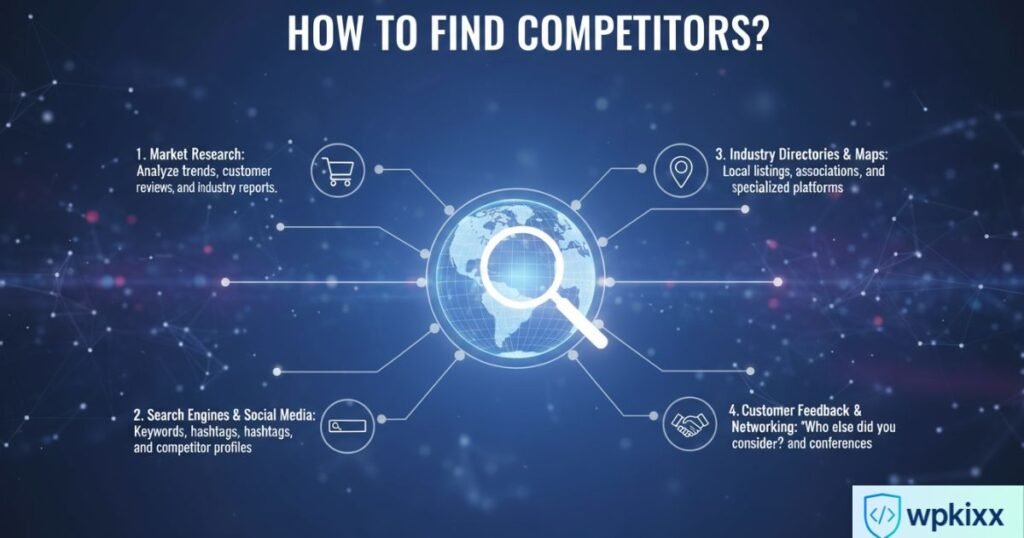
To find competitors, start with Google search — type your product or service keywords and document every business appearing consistently in results. Use keyword tools like Semrush or Ahrefs to identify domains ranking for your target keywords. Search social media platforms for your product category to find businesses targeting your audience. Ask your existing customers what other options they considered before choosing you. Check industry directories and review platforms like G2 or Yelp for your product category. These five methods together reveal your direct competitors, indirect competitors, and the full competitive landscape your US business operates within more comprehensively than any single method alone.
What is the best free tool to find competitors?
The best free tools to find competitors for US businesses are Google search for identifying who ranks for your keywords, Google Alerts for ongoing competitor monitoring, SimilarWeb’s free tier for traffic and audience competitor data, and Ubersuggest’s free tier for basic domain keyword analysis. Google Search Console reveals which competitors outrank your site for your current keywords — free data directly from Google about your search competitive position. For social competitor discovery, native platform search on LinkedIn, Instagram, and Reddit is free and often reveals competitors that search-focused tools miss entirely. These free tools provide sufficient intelligence for initial competitor discovery — upgrade to Semrush or Ahrefs when you need deeper keyword data and ongoing competitive monitoring capabilities.
How do I find competitors for a new business with no customers yet?
For a new US business without existing customers, finding competitors requires pure market research rather than customer feedback. Search Google for your product or service keywords across multiple angle combinations. Browse industry association directories in your specific market category. Search Amazon, Etsy, or relevant marketplaces for your product type. Review G2, Capterra, or Yelp for service providers in your category. Read industry publications and trade journals that cover your market segment. Join relevant Reddit communities and LinkedIn groups to observe which businesses community members recommend and discuss. These research methods collectively build a thorough competitive landscape map for any US business at the pre-launch stage without requiring any existing customer relationships to generate competitor intelligence through feedback channels.
How often should I research my competitors?
US businesses should conduct a thorough competitor analysis quarterly — reviewing competitor websites, pricing, product offerings, and content strategy every three months to catch significant market changes before they affect your business. Set up Google Alerts for continuous monitoring between quarterly reviews — these deliver competitor news and announcements in real time without requiring scheduled research sessions. Run keyword competitor reports in Semrush or Ahrefs monthly to track ranking shifts in your shared keyword space. Conduct a comprehensive annual competitive landscape review each January that identifies new market entrants, evaluates competitor growth trajectories, and updates your strategic positioning assumptions based on how the market has evolved over the preceding twelve months.
Can I find competitors without paid SEO tools?
Yes — you can find competitors effectively using only free tools. Google search reveals who ranks for your keywords. Google Alerts monitors competitor brand mentions automatically. SimilarWeb free tier shows competitor traffic estimates. Ubersuggest free tier provides basic keyword competitor data. Social media platform search identifies competitors targeting your audience on Instagram, LinkedIn, and TikTok. Customer interviews reveal competitors through authentic purchasing behavior data. Industry directories list businesses in your category. Review platforms like G2, Yelp, and Google Reviews map your competitive landscape through customer evaluations. These free methods cover the full competitor discovery process for US small businesses before paid tool investment becomes necessary. For more competitive research guides, visit wpkixx.com.

Final Thoughts: Make Competitor Research a Continuous Habit
Knowing how to find competitors is only the beginning — the real competitive advantage comes from building ongoing competitor monitoring into your regular business rhythm rather than treating it as a one-time project. Your competitive landscape evolves constantly — new entrants emerge, established competitors pivot, and customer preferences shift in ways that change which businesses compete most directly for your customers’ attention and budget. US businesses that review their competitive intelligence quarterly, monitor competitor activity continuously through automated alerts, and update their positioning strategy in response to market changes consistently outperform businesses that set their strategy once and assume the competitive environment stays static. Start with Google search and free tools today, add structured keyword research tools as your strategy matures, and build the competitor monitoring habits that keep your business ahead of every market change.