

SEO Strategy Template: 7 Proven Frameworks to Rank Higher and Drive Traffic in 2026
An SEO strategy template is the difference between a website that ranks on page one and a website that publishes content into a void — because without a structured framework connecting keyword research, content planning, on-page optimization, technical SEO, link building, and performance tracking into a coherent execution system, even high-quality content fails to accumulate the search authority that Google rewards with top rankings. The world’s leading SEO platforms — Ahrefs, Semrush, ClickMinded, and Plerdy — all publish SEO strategy templates precisely because structured planning is the most reliable predictor of SEO success across business sizes, industries, and competition levels. This guide covers 7 proven SEO strategy template frameworks — from Semrush’s beginner-accessible three-step plan to Ahrefs’ sophisticated Orchard methodology — with a complete step-by-step implementation guide, downloadable template structure, and tracking system that you can deploy for your website starting today.
1. What Is an SEO Strategy Template and Why You Need One
An SEO strategy template is a structured planning document that organizes every component of search engine optimization into a sequential, trackable execution framework — connecting the inputs (keyword research, competitor analysis, content creation, technical fixes) to the outputs (rankings, organic traffic, conversions) through a systematic process that produces predictable, compounding results over time. Without an SEO plan template, most website owners publish content randomly, fix technical issues reactively, and build links opportunistically — generating isolated SEO wins that don’t accumulate into the domain authority growth that produces page-one ranking positions for competitive keywords
Plerdy’s guide to SEO strategy templates defines an SEO plan as a complete road map for raising search engine results and increasing natural traffic — a definition that captures the template’s core function as both a planning tool and an execution tracker. Semrush’s SEO strategy guide identifies three essential components that every effective SEO strategy template must include: keyword research, keyword mapping, and content planning — with each component building on the previous to create a coherent search visibility strategy rather than isolated optimization tactics. Ahrefs’ Orchard SEO strategy adds benchmark setting and goal definition as prerequisites to keyword research — arguing that SEO strategy without performance measurement baselines produces activity without accountability. ClickMinded’s free SEO strategy template provides a laser-focused planning structure specifically designed to drive traffic rather than optimize for metrics that don’t translate to business outcomes. Together, these four authoritative frameworks provide the components of a complete SEO strategy template that any website owner can implement regardless of technical background or available resources
Core Components Every SEO Strategy Template Must Include
Component | What It Covers | Template Source |
|---|---|---|
SEO Benchmark + Goals | Current rankings, traffic, domain authority baseline | |
Keyword Research | Target keywords, search volume, difficulty, intent | |
Keyword Map | Assigning keywords to specific pages or new content | |
Content Plan | Article calendar, formats, word counts, internal linking | |
Technical SEO Audit | Site speed, crawlability, indexation, Core Web Vitals | |
Link Building Plan | Backlink acquisition targets, outreach strategy, DR goals | |
Tracking + Reporting | Monthly ranking, traffic, conversion measurement |
SEO Strategy Template vs SEO Tactics: Key Difference
Most website owners confuse SEO tactics (individual optimization actions like adding keywords to titles or building one backlink) with an SEO strategy (a coordinated system connecting keyword research, content creation, technical health, and authority building into a compounding growth framework). Tactics without strategy produce unpredictable, non-compounding results — occasional ranking improvements that don’t build on each other. Strategy without tactics produces plans that never execute. An effective SEO strategy template bridges both by documenting the strategic framework (which keywords, which content types, which technical priorities, which link building approaches) alongside the tactical execution calendar (what to do each week, in what sequence, with what resources) that turns strategic clarity into ranking results. ClickMinded’s template framework specifically addresses this distinction by building task-level execution guidance into the strategic planning document — making their free downloadable template one of the most immediately actionable SEO strategy templates available to non-technical website owners who need both direction and a specific to-do list to make progress
2. Ahrefs Orchard SEO Strategy Template
Ahrefs’ Orchard SEO Strategy is one of the most sophisticated and practically proven SEO strategy frameworks available — structured around the metaphor of planting and growing an orchard (your website’s content ecosystem) where initial ‘seed’ keywords generate additional keyword discovery that fills the content calendar organically rather than through manual brainstorming alone. The Orchard approach specifically addresses the most common SEO strategy template failure — running out of quality keyword targets after an initial research burst — by building keyword discovery into the ongoing strategy execution process rather than treating it as a one-time setup activity
The Ahrefs Orchard SEO strategy template follows four sequential phases: Phase 1 Plan — benchmark your current SEO performance using Ahrefs Site Explorer to establish organic traffic baseline, domain rating, and current ranking positions for all existing content. Phase 2 Plant — use ‘seed’ keywords (your core product/service terms) to identify broader content opportunity clusters through Ahrefs Keywords Explorer — discovering hundreds of related keywords that form your complete content calendar. Phase 3 Grow — execute content creation against the keyword plan systematically, tracking each published article’s ranking trajectory from publication through indexation and authority accumulation. Phase 4 Harvest — identify and optimize content that ranks on page two (positions 11 to 20) for high-value keywords — these near-miss rankings represent the highest-ROI optimization targets in any content portfolio because they need only incremental improvement to generate dramatically more traffic. Download Ahrefs’ free SEO strategy template directly from their blog to access the pre-built spreadsheet structure that implements all four phases without building from scratch
Ahrefs Orchard Template: Phase-by-Phase Implementation
- Phase 1 — Plan: Run Ahrefs Site Audit for technical baseline; document current top 20 ranking pages and their traffic contribution; set 6 and 12-month organic traffic growth targets
- Phase 2 — Plant: List 5-10 seed keywords representing your core topics; expand each through Ahrefs Keywords Explorer; filter to KD under 30 and volume over 500/month for starter content targets
- Phase 3 — Grow: Publish 2-4 articles per week targeting mapped keywords; add internal links to new content from existing pages; monitor Google Search Console for indexation confirmation
- Phase 4 — Harvest: Monthly audit — filter all pages to positions 11-20 in Google Search Console; prioritize top 10 for targeted optimization (title update, content expansion, internal link addition)
3. Semrush SEO Strategy Template: 3-Step Beginner Framework
Semrush’s SEO strategy guide provides the most beginner-accessible SEO strategy template framework available from a major SEO platform — reducing the complexity of comprehensive SEO planning into three essential steps that any website owner can execute regardless of technical background. Semrush’s three-step framework has been validated across thousands of websites and represents the minimum viable SEO strategy that consistently produces organic traffic growth when executed systematically over 6 to 12 months
Step 1: Keyword Research — using Semrush’s Keyword Magic Tool to identify keywords with sufficient search volume, manageable difficulty, and clear commercial or informational intent that aligns with your website’s purpose. Semrush recommends targeting a mix of head terms (high volume, competitive), body keywords (medium volume, moderate competition), and long-tail keywords (low volume, low competition, high conversion intent) — building a keyword portfolio that generates traffic at every stage of your SEO authority growth. Step 2: Keyword Map — assigning each researched keyword to a specific existing page or planned new page on your website, ensuring no two pages target the same keyword (which creates cannibalization that dilutes ranking potential) and every important keyword has a dedicated page optimized for it. Step 3: Content Plan — creating a prioritized editorial calendar that sequences content creation from lowest keyword difficulty to highest, building domain authority through early ranking wins before tackling competitive terms that require established authority to rank for. Stackby’s SEO Strategy Template provides a free-to-use database template that implements all three Semrush steps with built-in keyword tracking, content plan management, and performance insight columns that don’t require custom spreadsheet building
Semrush Keyword Research Framework for Your SEO Template
- Head terms (1-2 words) — volume 10K-100K+; KD 60-90; target for year 2+ once domain authority established; brand awareness value
- Body keywords (2-3 words) — volume 1K-10K; KD 30-60; primary 6-12 month targets; highest traffic-to-competition ratio
- Long-tail keywords (4+ words) — volume 100-1K; KD 0-30; start here; fastest rankings; highest commercial intent
- Question keywords — ‘how to’, ‘what is’, ‘best way to’; featured snippet opportunity; voice search compatible; FAQ content targets
- Local keywords — [service] + [city]; KD often very low; high commercial intent; critical for local business SEO strategy templates
Semrush Keyword Map Template Structure
A keyword map — the second step in Semrush’s SEO strategy template — is a spreadsheet document assigning every target keyword to a specific URL on your website. Each row in the keyword map contains: Target URL, Primary Keyword (the main focus keyword for that page), Secondary Keywords (2-4 supporting keywords that the same page should naturally incorporate), Monthly Search Volume, Keyword Difficulty Score, Content Status (existing/planned/in progress/published), and Current Ranking Position. Stackby’s SEO strategy template provides this keyword map structure as a ready-to-use database with built-in filtering, sorting, and progress tracking — saving the 2 to 4 hours typically required to build a keyword map spreadsheet from blank columns. Review and update your keyword map monthly — adding new keyword opportunities discovered through Google Search Console‘s Performance report (queries your site is appearing for that haven’t been formally mapped yet) and removing keywords where intent or competition has shifted since initial research
4. ClickMinded Free SEO Strategy Template
ClickMinded’s free SEO strategy template is specifically designed for website owners who are ‘struggling to plan their SEO’ — providing a laser-focused planning structure that emphasizes traffic-driving execution over theoretical framework completeness. ClickMinded’s approach reflects their practical training methodology: provide the minimum viable planning structure needed to drive measurable traffic results, built around the specific actions that produce rankings rather than the comprehensive documentation that produces impressive-looking strategy documents without corresponding search performance
The ClickMinded SEO strategy template download includes five core sections: Website and Competitive Analysis (documenting your domain authority baseline and top three competitor SEO profiles), Keyword Research Document (organized by topic cluster with volume, difficulty, and intent annotations), Content Production Calendar (monthly article schedule with keyword targets, word count guidelines, and publishing dates), On-Page Optimization Checklist (applied to every published article to ensure consistent technical SEO implementation), and Monthly Tracking Dashboard (organic sessions, keyword position changes, backlink growth). Reddit’s SEO community consistently recommends ClickMinded’s template as the most practical free starting point for website owners building their first SEO strategy — because its focus on execution over documentation avoids the common failure of elaborate strategy templates that are too complex to maintain consistently month over month. Download the ClickMinded template at clickminded.com/templates/seo/seo-strategy-template and adapt the sections to your specific website before populating with your keyword research data
ClickMinded SEO Template: On-Page Optimization Checklist
- Title tag — include primary keyword; keep under 60 characters; front-load keyword; compelling for click-through rate
- Meta description — include primary and one secondary keyword; 128-155 characters; action-oriented; unique per page
- H1 tag — one H1 per page; include primary keyword; matches searcher intent exactly
- H2-H3 structure — include secondary keywords naturally; organize content logically for featured snippet opportunities
- URL slug — short, keyword-inclusive; hyphens between words; no stop words; matches page topic precisely
- Image alt text — descriptive with keyword where natural; improves image search visibility and accessibility
- Internal links — 3-5 internal links to related pages per article; anchor text includes target keyword of destination page
- Word count — match or exceed top 3 ranking pages; longer content ranks better for competitive informational keywords
5. Plerdy’s 6 SEO Strategy Template Types
Plerdy identifies six distinct SEO strategy template types that serve different website goals, business sizes, and competitive environments — confirming that a single universal SEO template is less effective than a template matched to your specific situation. Understanding which of Plerdy’s six template types applies to your website ensures your SEO strategy addresses the constraints and opportunities most relevant to your specific search environment
The six Plerdy SEO strategy template types are: the New Website Template (zero authority starting point — focuses on quick-win long-tail keywords, technical foundation, and local citations before competitive keyword targeting), the E-commerce Template (product page optimization, category page keyword mapping, shopping intent content, and Google Shopping integration), the Local Business Template (Google Business Profile optimization, local citation building, near-me keyword targeting, and review generation), the Content Marketing Template (blog-driven authority building, topic cluster architecture, editorial calendar management, and featured snippet targeting), the Enterprise Template (large-scale technical SEO, international targeting, multi-language content strategy, and cross-team coordination), and the Recovery Template (for websites experiencing Google penalty or traffic decline — audit-first approach focusing on toxic link removal, content quality improvement, and Core Web Vitals restoration). Select your template type before building your strategy — a local restaurant applying an enterprise content marketing template wastes resources on irrelevant tactics, while a national e-commerce brand applying a local business template misses the national search opportunity their budget could capture
Which SEO Strategy Template Type Do You Need?
- New website (0-6 months old): New Website Template — long-tail keywords, technical foundation, local citations first
- E-commerce store: E-commerce Template — product/category page optimization, shopping intent content, schema markup
- Local service business: Local Business Template — Google Business Profile, near-me keywords, review strategy
- Blog/content publisher: Content Marketing Template — topic clusters, editorial calendar, featured snippets
- Penalized or declining site: Recovery Template — technical audit first, toxic link disavow, content quality review
- Large multi-department business: Enterprise Template — technical SEO governance, international, cross-team workflows
6. Building Your Own SEO Strategy Template From Scratch
While downloading pre-built SEO strategy templates from Ahrefs, ClickMinded, and Stackby saves initial setup time, building a custom SEO strategy template tailored to your specific website provides the additional advantage of matching every template section precisely to your actual workflow, available tools, team structure, and competitive environment. The following framework builds a complete SEO strategy template from scratch using Google Sheets (free) — with six tabs covering every component identified as essential by the leading SEO strategy guides from Semrush, Ahrefs, ClickMinded, and Plerdy
Tab 1 — SEO Baseline Dashboard: Document current organic sessions (monthly), domain authority, number of indexed pages, number of pages ranking in top 10, top 5 traffic-driving pages, and primary competitor comparison across the same metrics. Update monthly to track strategy progress. Tab 2 — Keyword Research Database: All target keywords with columns for keyword, search volume, keyword difficulty (0-100), search intent (informational/commercial/navigational/transactional), keyword cluster/topic, status (researched/assigned/in-content/ranking), and target URL. Tab 3 — Content Calendar: Monthly editorial schedule with columns for publish date, article title, primary keyword, secondary keywords, target word count, writer, status (planned/in-progress/published), and published URL. Tab 4 — Technical SEO Tracker: Issues discovered through Google Search Console and site audit tools — columns for issue type, affected pages, priority (high/medium/low), assigned to, and resolution date. Tab 5 — Backlink Tracker: Target domains for link acquisition, current linking domain count, monthly DR growth. Tab 6 — Monthly Reporting: Automated metrics summary for stakeholder communication
Free Tools to Populate Your SEO Strategy Template
Template Section | Free Tool | What It Provides | Access At |
|---|---|---|---|
Keyword Research | Google Keyword Planner | Volume and competition data | |
Competitor Analysis | Ahrefs Free Tools | Top pages, keyword gaps | |
Technical SEO Audit | Screaming Frog (500 URLs free) | Crawl errors, redirect chains | |
Rankings Tracking | Google Search Console | Rankings, impressions, CTR | |
Backlink Analysis | Moz Link Explorer (free) | Domain authority, backlinks | |
Content Optimization | Rank Math (free plugin) | Real-time on-page scoring |
7. Monthly SEO Strategy Template Execution Calendar
The most common failure of even well-designed SEO strategy templates is inconsistent execution — weekly content publishing that misses deadlines, monthly technical audits that get postponed indefinitely, and link building outreach that never gets initiated because no specific calendar obligation makes it a scheduled priority. Building a monthly SEO execution calendar into your template converts strategic documentation into scheduled habits that produce results regardless of competing priorities or motivation fluctuations
The optimal monthly SEO strategy template execution schedule for most website owners — confirmed by community recommendations in Reddit’s SEO subreddit — allocates time across four weekly focuses: Week 1 — publish 2 new articles from content calendar + update 1 existing page from positions 11-20 harvest list. Week 2 — link building outreach (5-10 personalized emails to link prospects) + Google Search Console review for new keyword opportunities. Week 3 — publish 2 new articles + social distribution of all published content. Week 4 — monthly metrics review (update SEO Baseline Dashboard) + technical SEO check (crawl errors, new 404s, Core Web Vitals) + content calendar planning for next month. This 4-week rotation ensures every SEO strategy component receives regular attention without any single week requiring more than 5 to 10 hours of dedicated SEO work — sustainable for individual website owners and small content teams. For more SEO strategy guides and templates, visit wpkixx.com.
12-Month SEO Strategy Template: Milestone Roadmap
- Month 1-2: Technical SEO foundation complete; Google Search Console + Analytics configured; keyword research database built; first 10 articles published
- Month 3-4: First rankings appearing for long-tail targets; content calendar in steady execution; internal linking structure established; 25+ articles published
- Month 5-6: Traffic growth visible in Analytics; first featured snippets for question keywords; link building outreach initiated; 50 articles published
- Month 7-9: Body keywords entering top 20; domain authority improving; 3-5 backlinks acquired monthly; 70+ articles published
- Month 10-12: Measurable organic traffic milestone reached; top 10 for multiple target keywords; 100 articles published; head terms entering top 30
8. SEO Strategy Template for Local Businesses
Local business SEO strategy templates differ structurally from content marketing or e-commerce templates because the primary ranking signals for local search — Google Business Profile completeness, local citation consistency, near-me keyword targeting, and review volume — require different execution priorities than the content creation and link building that dominate organic SEO strategy. Local businesses using a generic SEO strategy template designed for national content publishers consistently underperform because they invest in blog content when their ranking bottleneck is citation inconsistency or an unclaimed Google Business Profile that blocks local pack visibility entirely
A local business SEO strategy template prioritizes five components in sequence: First, Google Business Profile optimization — complete every field including business description with primary local keywords, service areas, business hours, photos (minimum 20), and Q&A section. Second, local citation building — consistent NAP (Name, Address, Phone) across Yelp, BBB, Angi, and 30+ industry-specific directories. Third, near-me keyword content — service + city landing pages optimized for ‘[service] near me’, ‘[service] in [city]’, and ‘[service] [city] [neighborhood]’ variations. Fourth, review generation strategy — systematic post-service review request via email or SMS with direct Google Business Profile review link. Fifth, local link building — chamber of commerce membership, local business association, and community sponsorship links that drive local authority signals that national link building strategies don’t prioritize. Visit wpkixx.com for local-specific SEO strategy guides
Local SEO Strategy Template Priority Checklist
- Google Business Profile — claimed, verified, complete, 20+ photos, respond to all reviews within 24 hours
- NAP consistency audit — run Moz Local or BrightLocal to identify and fix inconsistent citations across all directories
- Service + city landing pages — dedicated page for each primary service in each city/neighborhood served; unique content per page
- Local schema markup — LocalBusiness schema on homepage; service schema on service pages; review schema where applicable
- Review velocity — target 5 new Google reviews per month minimum; respond to all reviews publicly within 48 hours
9. Tracking and Measuring Your SEO Strategy Template Performance
An SEO strategy template without a performance tracking framework is a planning document rather than a management system — because without measuring ranking progress, traffic growth, and conversion impact monthly, strategy adjustments that would prevent months of misdirected effort never happen. Stackby’s SEO strategy template specifically emphasizes managing keywords, content plans, and performance insights as integrated components of a single strategy management system rather than separate tracking exercises — recognizing that ranking data and content production data must be visible in the same document to make strategy-adjusting decisions efficiently
The five SEO performance metrics that should appear in every SEO strategy template tracking section are: Organic Sessions (monthly, from Google Analytics — the primary SEO traffic metric), Keyword Rankings (track top 20 target keywords in Google Search Console Position report monthly), Click-Through Rate (GSC Performance report — low CTR for ranking pages signals title/meta description optimization needed), Domain Rating or Authority (track with Ahrefs or Moz monthly — authority growth predicts future ranking capacity), and Organic Conversions (Google Analytics Goal completions or e-commerce revenue from organic traffic — the ultimate business ROI metric for SEO strategy investment). Set specific numeric targets for each metric at 3, 6, and 12 months from strategy launch — comparing actual versus target performance monthly creates the accountability structure that differentiates strategy-driven SEO from random optimization activity
Monthly SEO Reporting Template Structure
- Executive summary: 2-3 sentences on overall organic performance direction this month vs last month
- Organic traffic: Monthly sessions + year-over-year comparison + traffic source breakdown (branded vs non-branded)
- Keyword rankings: Top 10 ranking improvements and declines this month; new page-one keywords; lost rankings
- Content published: Articles published this month; total live content count; average word count
- Link building: New backlinks acquired; referring domain count growth; DR/DA change
- Technical health: Crawl errors resolved; Core Web Vitals status; indexation coverage
- Next month priorities: Top 3 action items based on this month’s data analysis
10. Frequently Asked Questions: SEO Strategy Template
What should an SEO strategy template include?
A complete SEO strategy template should include: SEO performance baseline (current traffic, rankings, domain authority), keyword research database (targets with volume and difficulty), keyword map (keywords assigned to specific URLs), content production calendar, on-page optimization checklist, technical SEO audit tracker, link building plan, and monthly performance reporting dashboard. Ahrefs’ Orchard template covers all eight components in a downloadable format. Semrush’s strategy guide reduces to the three most essential: keyword research, keyword map, and content plan — sufficient for beginners. Visit wpkixx.com for more SEO strategy resources.
Where can I download a free SEO strategy template?
The best free SEO strategy template downloads in 2026 are: ClickMinded’s free SEO template (most practical, execution-focused), Ahrefs’ Orchard template (most sophisticated, best for established sites), Stackby’s free SEO template (best database format with tracking built in), and Plerdy’s 6 template collection (best variety by business type). All four are genuinely free — ClickMinded and Ahrefs require email signup, Stackby and Plerdy provide direct access without registration.
How often should I update my SEO strategy template?
Update your SEO strategy template monthly for tracking metrics (rankings, traffic, backlinks) and quarterly for strategic decisions (keyword priority shifts, new content clusters, technical SEO focus changes). Reddit’s SEO community recommends a quarterly strategy review cycle — reviewing what’s working, what’s underperforming, and what Google algorithm updates may require template adjustments. Annual complete template rebuilds are appropriate for significant website pivots, major competitor landscape changes, or after algorithm updates that substantially alter which content types and topics are rewarded in your specific niche.
What is the difference between an SEO strategy and an SEO plan?
An SEO strategy defines the high-level approach — which keyword categories to target, which content formats to prioritize, which authority-building methods to use — while an SEO plan (or content plan) is the tactical execution schedule implementing the strategy — specific articles to write, specific technical fixes to implement, specific outreach emails to send, by specific dates. Plerdy’s SEO strategy template definition captures both as components of a single ‘complete road map’ — confirming that strategy and plan function together most effectively when housed in the same document rather than maintained as separate frameworks that require manual coordination. Visit wpkixx.com for more SEO guides.
How long does it take to see results from an SEO strategy template?
Following a structured SEO strategy template consistently produces visible results in 3 to 6 months for most websites — with new websites typically showing first significant traffic growth at the 6 to 9 month mark after domain authority establishes sufficient trust for competitive keyword rankings. Semrush’s strategy framework sets realistic expectations that SEO compounds over time — month 1 to 3 produces minimal traffic but essential foundation, months 4 to 9 produce accelerating traffic growth as content accumulates, and months 10 to 18 deliver full compounding benefits from the complete content and authority ecosystem. Consistency with the SEO template execution calendar is the primary timeline determinant — sites executing consistently outperform sites with superior strategies executed sporadically. For more SEO timeline guides, visit wpkixx.com.
Final Thoughts: Using an SEO Strategy Template in 2026
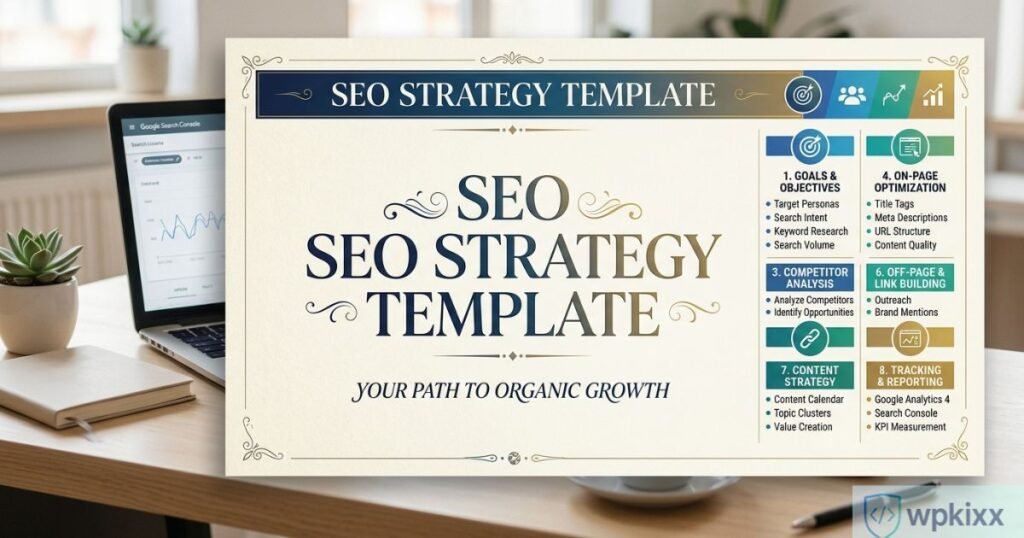
An SEO strategy template is the single most effective SEO investment a website owner can make — because it transforms SEO from a reactive collection of isolated optimization actions into a coordinated growth system that compounds authority, traffic, and rankings over time. Start with ClickMinded’s free template download for immediate execution capability, reference Semrush’s three-step keyword research framework for your keyword database foundation, adopt Ahrefs’ Orchard methodology for ongoing keyword discovery, and use Stackby’s template for integrated content plan and performance tracking in a single manageable database. Choose the template type from Plerdy’s six-category framework that matches your website’s current situation — and commit to monthly template execution for 12 consecutive months before evaluating strategic changes. The SEO strategy templates that produce page-one rankings are not the most elaborate ones — they are the ones executed most consistently. For more SEO strategy guides, template resources, and organic traffic growth frameworks updated throughout 2026, visit wpkixx.com.