
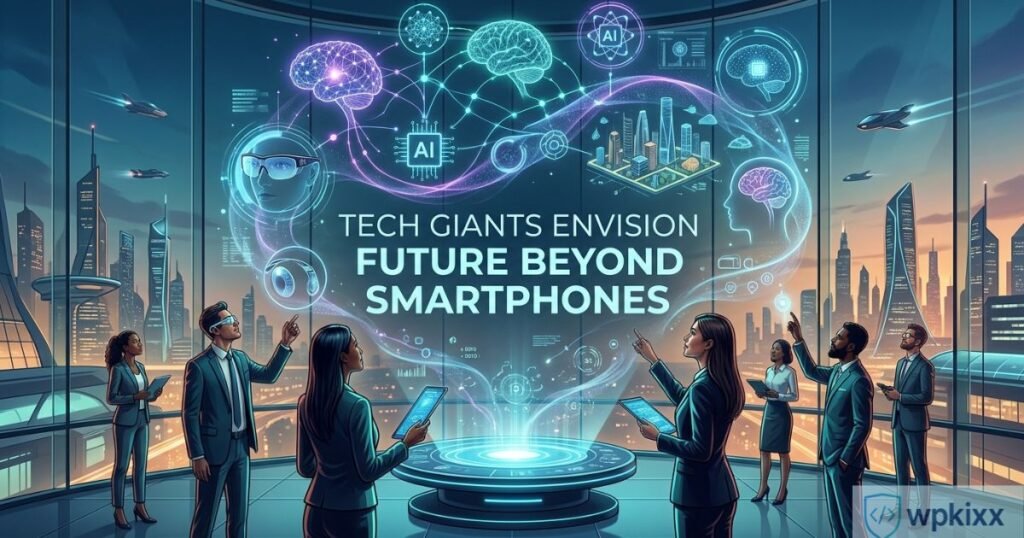
Tech Giants Envision Future Beyond Smartphones: 7 Technologies Reshaping Computing in 2026
The world’s most powerful technology companies — Apple, Google, Meta, Microsoft, and Samsung — are collectively investing hundreds of billions of dollars in the conviction that the future beyond smartphones is arriving faster than most users expect, and that the company that defines the next computing platform after the smartphone will achieve the same category defining dominance that Apple achieved with the iPhone in 2007 and Microsoft achieved with Windows in the 1990s.
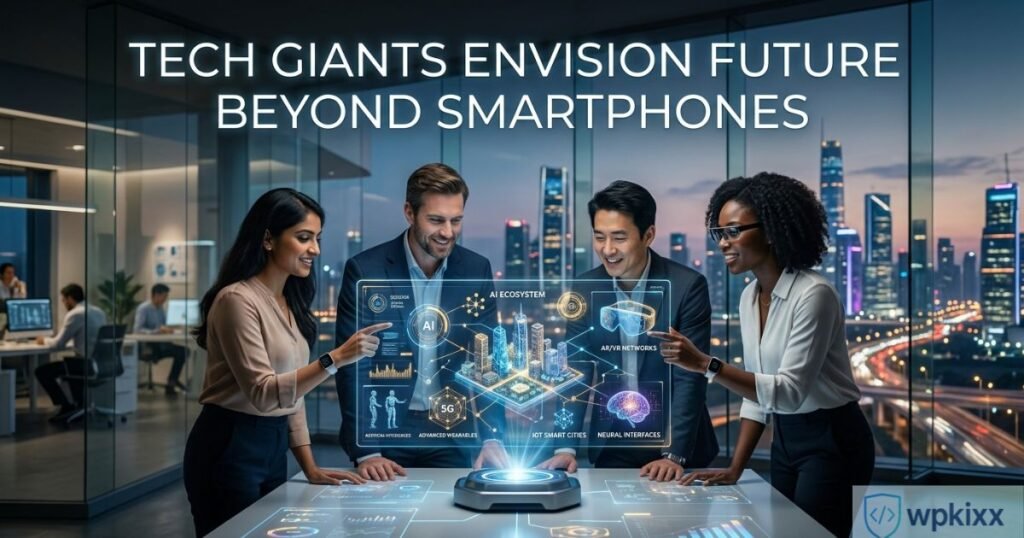
The tech giants envisioning a future beyond smartphones share a common thesis: that artificial intelligence, augmented reality, ambient computing, and new human computer interface paradigms will make the rectangular glass slab that has defined personal computing for 15 years obsolete — replaced by computing that is more contextual, more spatial, more conversational, and less dependent on the user’s conscious attention to a screen.
This guide covers the 7 most significant technologies that tech giants are betting on to define the post smartphone future in 2026 and beyond.
1. Augmented Reality Glasses: The Primary Smartphone Replacement Candidate
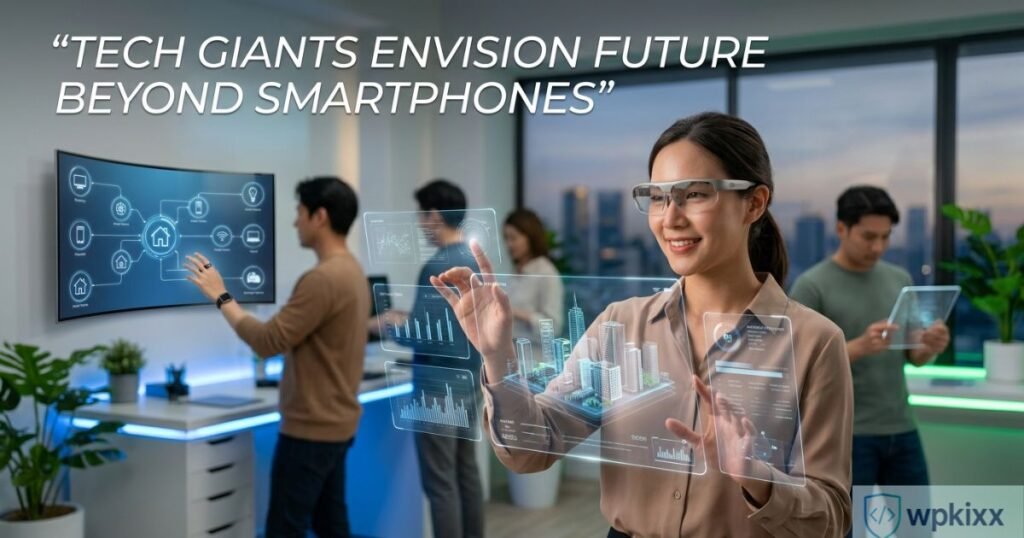
Augmented reality glasses — overlaying digital information onto the physical world through transparent lenses — represent the consensus tech giant bet for the most likely smartphone replacement computing platform. Apple, Meta, Google, and Samsung are all actively developing AR glasses products at various stages from prototype to market release, reflecting the industry wide conviction that spatial computing through wearable AR is the natural successor to smartphone centric computing.
Apple’s Vision Pro represents the highest end current implementation — a spatial computing headset rather than true glasses, but establishing the software ecosystem and developer relationships that will power thinner AR glasses when display and battery technology permits.
Meta’s Ray Ban Meta smart glasses already sell in the millions, providing AI assistant access and camera capability in conventional looking frames — a stepping stone toward full AR overlay displays.
Google’s renewed AR glasses investment following the Google Glass era reflects the company’s AI first strategy: glasses that serve as the ambient AI interface that makes the smartphone’s screen centric interaction model unnecessary for information retrieval, communication, and navigation tasks that currently require pulling out a phone.
AR Glasses Timeline: Tech Giants Roadmap
Company | Current Product | Next Step | Full AR Vision |
|---|---|---|---|
Apple | Vision Pro headset | Lighter AR glasses (2026 2027) | iPhone replacement companion |
Meta | Ray Ban Meta glasses | AR overlay display glasses | Social AR metaverse platform |
AR research + Pixel AI | Consumer AR glasses | AI ambient computing layer | |
Samsung | Galaxy Ring wearable | AR glasses (Project Moohan) | Galaxy ecosystem integration |
2. AI Wearables: The Ambient Computing Layer
AI wearables — from the Humane AI Pin to the Rabbit R1 to Meta’s AI powered Ray Ban glasses — represent tech giants’ vision of ambient computing beyond smartphones: devices that provide constant AI assistant access without requiring the user to pull out a phone, unlock it, and navigate to an app. The fundamental pitch of AI wearables is that intelligence should be ambient — always available, contextually aware of your environment, and accessible through natural speech or subtle gesture rather than screen mediated interaction.
While first generation AI wearable devices received mixed reviews for their capability limitations, the underlying thesis that computing should become less screen dependent and more contextually intelligent represents the consensus direction for post smartphone computing.
Amazon’s Echo Frames, Samsung’s Galaxy AI integration across devices, and Apple’s expanding Siri capabilities all reflect the same conviction: the future beyond smartphones is a computing environment where AI handles the lookup, communication, and task execution that currently requires conscious smartphone interaction — freeing human attention from screens and returning it to physical reality.
3. Brain Computer Interfaces: The Long Term Vision
Neuralink’s first human implants and the broader brain computer interface (BCI) research field represent the most radical tech giant vision of computing beyond smartphones — direct neural interfaces that eliminate all physical input devices by enabling thought to computer communication.
While practical consumer BCIs remain years from mass market, the billions invested in BCI research by Elon Musk’s Neuralink, Meta’s neural interface research, and DARPA reflect serious institutional conviction that neural computing represents a legitimate long term direction for human computer interaction.
4. Voice First AI: Amazon, Google, and Apple Competing
The voice first AI computing paradigm — where conversational AI replaces screen based smartphone interaction for most everyday tasks — is already partially implemented through Amazon Alexa, Google Assistant, Apple Siri, and OpenAI’s voice interfaces.
The future beyond smartphones in the voice first model is a computing environment where AI is so capable and contextually aware that most information retrieval, communication, shopping, and navigation tasks can be completed through natural speech without a screen at all — smartphone as optional accessory rather than required interface.
5. Spatial Computing and Mixed Reality
Apple’s introduction of the term “spatial computing” with Vision Pro signals the company’s official framing for the post smartphone computing paradigm — a three dimensional digital environment that overlays on and integrates with physical space rather than confining computing to a two dimensional screen. Microsoft’s HoloLens, focused on enterprise applications, already demonstrates spatial computing’s practical value for manufacturing, healthcare, and engineering — industries where hands free, spatially anchored digital information dramatically improves worker capability.
The tech giant spatial computing investments collectively point toward a future where the smartphone’s screen is replaced by a spatial canvas — digital content placed in physical space, manipulated with hands and gaze, and experienced without the social isolation of staring at a handheld screen. Whether this transition happens in 5 years or 15 depends on display technology maturation, battery energy density improvements, and the developer ecosystem willingness to rebuild apps for spatial interaction paradigms.
6. Wearable Health Computing: The Body as Interface
Apple Watch, Samsung Galaxy Watch, Google’s Fitbit integration, and the emerging category of smart rings (Samsung Galaxy Ring, Oura Ring) represent tech giants’ vision of the body itself as a computing platform — wearables that monitor health continuously, provide computing capability without requiring phone extraction, and eventually serve as the primary interface for AI mediated computing through biometric context and gesture input.
The health computing wearable trajectory points toward devices that know your physiological state (stress, sleep quality, activity, illness indicators) and use that context to proactively surface information and complete tasks without requiring explicit phone interaction — the beyond smartphone computing model where the device understands your needs from context rather than waiting for you to open an app.
7. The Post Smartphone Timeline: What Tech Giants Are Building For
Tech giants envisioning a future beyond smartphones are primarily building for a 2028 to 2035 transition window — when AR display technology reaches sufficient resolution and field of view at wearable form factors, battery energy density enables all day AR glasses usage, AI capability makes ambient computing genuinely more useful than phone centric computing, and 5G/6G network ubiquity enables the cloud edge computing architecture that wearable devices require.
The smartphone will not disappear suddenly — it will gradually cede primary computing status as AR glasses and AI wearables demonstrate specific use cases where they are meaningfully better than phone interaction, expanding those advantages until the phone becomes the secondary device in the computing ecosystem rather than the primary one. For more technology trend analysis and guides, visit wpkixx.com.
Frequently Asked Questions: Future Beyond Smartphones
When will smartphones be replaced?
Tech giants building post smartphone computing platforms target a 2028 2035 transition window for AR glasses to reach sufficient capability to serve as primary computing devices for early adopters. Mass market smartphone replacement — where the majority of users adopt alternative primary computing devices — is more likely in the 2030 2040 range. Smartphones will remain prevalent and useful long after alternatives emerge, just as laptops remained common after smartphones became primary computers for many users.
What will replace smartphones?
The consensus tech giant bet is that AR glasses will be the primary smartphone replacement — providing the always available, context aware computing experience that smartphones offer but without requiring users to look at a handheld screen. AI wearables, voice first AI interfaces, and spatial computing platforms are complementary approaches that different companies are pursuing as paths to the same post smartphone future. Visit wpkixx.com for more technology future guides.