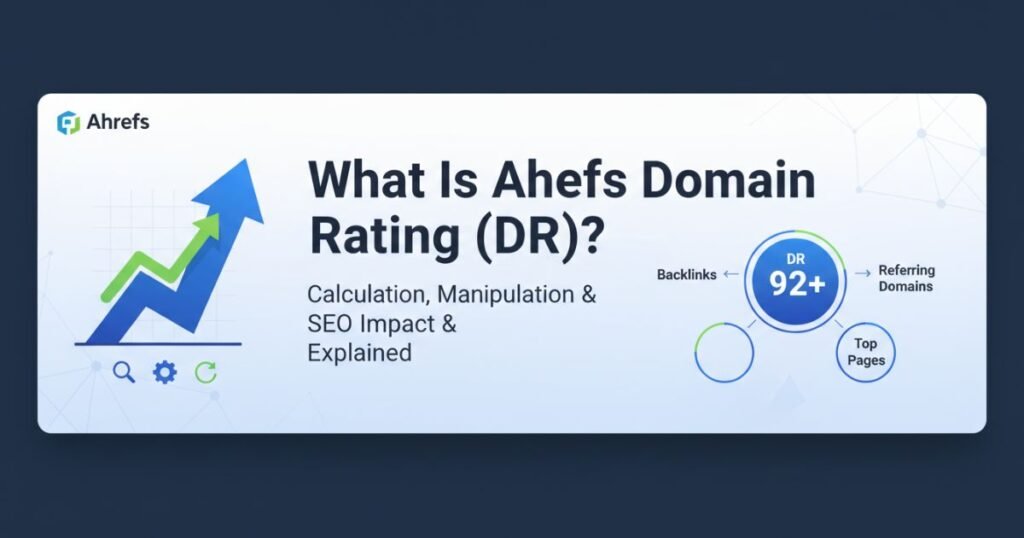
If you’re diving into SEO, one question keeps popping up: What is DR & How It Is Calculated? Domain Rating (DR) is a popular metric developed by Ahrefs to measure the strength of a website’s backlink profile on a scale from 0 to 100. In simple terms, it reflects your site’s overall authority compared to others in the database. Many marketers confuse it with Google’s ranking factors, but DR is a third-party indicator used for competitive analysis and link evaluation. Understanding Domain Rating, its calculation method, and how backlink profile strength influences your score helps you make smarter decisions about SEO authority metrics and improve your referring domains strategy.
What Is Ahrefs Domain Rating (DR)?
Let’s answer clearly: what is domain rating? Domain Rating (DR) is an SEO authority score created by Ahrefs. It measures the strength of your backlink profile strength compared to other websites in their database. It is not owned by Google, yet it reflects authority signals similar to old PageRank logic.
In short, domain rating in SEO shows how powerful your domain looks based on referring domains, root domains, and passed link equity. Think of it as a public authority thermometer. A low domain rating website has fewer quality links. A strong site has many high authority backlinks and a healthy natural link profile.
How Does Ahrefs Calculate Domain Rating?
Many ask, how is domain rating calculated? Ahrefs focuses mainly on the number and quality of referring domains linking to you. It measures how much link juice flows from those domains and adjusts scores using a logarithmic scale. More links do not mean automatic growth.
Here is how how domain rating works in simple steps:
- Count unique referring domains
- Measure strength of linking domains
- Analyze distribution of dofollow backlinks
- Reduce value when links are over-shared
- Compare against the full index
| Factor | Impact on Domain Rating (DR) |
| High DR linking site | Strong boost |
| Many outbound links | Diluted value |
| nofollow backlinks | Limited impact |
| Spam patterns | Possible decline |
DR vs DA vs UR – What’s the Real Difference?
The debate around domain rating vs domain authority is common. Domain Authority (DA) from Moz and Authority Score from SEMrush measure authority differently. That is the real DR vs DA difference. Each tool uses its own index and algorithm.
Here is a simple domain authority comparison table:
| Metric | Tool | Focus |
| Domain Rating (DR) | Ahrefs | backlink profile strength |
| Domain Authority (DA) | Moz | Predictive ranking ability |
| Authority Score | SEMrush | Overall domain quality |
| Domain Strength | SpyFu | Ranking consistency |
| Trust Flow | Majestic | Link trust |
| Citation Flow | Majestic | Link quantity |
This makes trust flow vs domain rating and citation flow comparison useful for deeper analysis.
Does Google Use Domain Rating for Rankings?
A common question is: does Google use domain rating? Officially, no. Google does not use Domain Rating (DR) directly. It uses complex Google ranking algorithm systems based on hundreds of SEO signals.
However, there is strong ranking correlation. Sites with higher DR often have strong sitewide authority, better search visibility, and win tough SERP competition. That is because strong links influence search ranking signals, even if DR itself is third-party.
Why Domain Rating Actually Matters in SEO
Even though it is not a direct domain rating ranking factor, DR still matters. It helps in competitor domain rating analysis. You can compare your domain with others before targeting competitive U.S. keywords.
It is also powerful for domain rating for link building and domain rating for guest posting. When selecting outreach targets, marketers prefer sites with higher domain strength score and strong organic rankings. That improves authority flow and protects against toxic backlinks.
Can Domain Rating Be Manipulated?
Yes, domain rating manipulation exists. Some people buy expired domains or build private networks to create fake DR increase. They push short-term gains using artificial link building for DR tactics.
However, this often leads to penalties. Patterns like unnatural anchors, spam clusters, and weak anchor text diversity damage credibility. A site with inflated DR but poor traffic usually fails long term. Smart SEO focuses on genuine high DR backlinks and editorial trust.
What Is a Good Domain Rating Score?
There is no universal good domain rating score. It depends on your niche. A DR 30 site may dominate a local industry. In SaaS or finance, DR 70 may be average.
Quick benchmark:
- DR 0–20 → New or small blogs
- DR 20–50 → Growing businesses
- DR 50–70 → Strong authority sites
- DR 70+ → Established industry leaders
Always check domain rating score next to traffic and conversions.
How to Increase Domain Rating the Right Way
If you want to increase domain rating fast, focus on quality not shortcuts. Here is how to improve domain rating safely:
- Earn editorial high authority backlinks
- Publish data-driven content
- Audit and remove toxic backlinks
- Strengthen internal linking
- Maintain a diverse natural link profile
Case Study Example:
A U.S. SaaS company improved DR from 28 to 54 in 12 months. They focused on digital PR, research reports, and partnerships. No spam tactics. Steady growth.
That is the safest way for how to boost DR.
Common Myths About Domain Rating
Many believe DR guarantees rankings. That is false. It shows probability, not certainty. Another myth is that thousands of links are required. In reality, strong link equity from a few quality domains works better.
Some also confuse DR with actual authority. Remember, it is an external metric. It supports strategy but does not replace content, UX, or technical health.
Final Verdict: Should You Focus on DR or Real SEO Metrics?
So, what is domain rating really? It is a guide. It reflects authority patterns across the web. It helps you evaluate competitors, partnerships, and outreach quality.
However, smart marketers focus on traffic, revenue, and conversions. Use Domain Rating (DR) alongside broader SEO metrics & concepts. Balance link growth with content excellence. Follow authority. Do not chase numbers blindly.
FAQ’s
Here are the top 5 searched questions with short, clear FAQ-style answers:
1️⃣ What is Domain Rating (DR) in Ahrefs?
Domain Rating (DR) is a metric by Ahrefs that measures the strength of a website’s backlink profile on a scale from 0 to 100. It shows how powerful a domain is compared to others in the Ahrefs database.
2️⃣ What is Domain Rating (DR) in SEO?
Domain Rating in SEO refers to a third-party authority score that estimates a website’s backlink strength and ranking potential. It is not a direct Google ranking factor but strongly correlates with authority.
3️⃣ What is a Good Domain Rating?
A good Domain Rating depends on your niche. DR 20–40 is solid for small businesses, while competitive industries often require DR 60+ to compete effectively.
4️⃣ Domain Rating vs Domain Authority – What’s the Difference?
Domain Rating is created by Ahrefs and focuses mainly on backlink quality, while Domain Authority (DA) by Moz uses a different algorithm to predict ranking ability. Both measure authority but calculate it differently.
5️⃣ How Can I Check My Domain Rating?
You can use the Ahrefs Domain Rating checker to instantly see your DR score. Other tools like Moz and SEMrush offer similar authority metrics for comparison.